
Alone With My Thoughts – 08/15/2022
The definition of a bear market is pretty straight forward…a 20% drop over 2+ months from previous highs. That is what we are in and there have been only 3 bear occurrences since 2000, with one of them lasting just 33 days (2020). (Technically, the Nasdaq market has now entered bull market territory, having rebounded 20% higher than its recent low). The idea of being in a recession appears to come with a bit more debate…is it two consecutive quarters of negative GDP growth, or a combination of negative growth, high inflation, and an increase in unemployment. While we wait for the bureaucrats to argue the definition, let’s consider two things, one, once they label a recession, we are probably on our way out of it, and two, recessions should be viewed with respect to their level of magnitude. With a strong jobs report and now a cooling of inflation from recent highs, the economy appears to be hanging in there. If the recession remains mild, and inflation tempers, that could be the definition of a recovering stock market.
The Longest Shot Has Won the Kentucky Derby
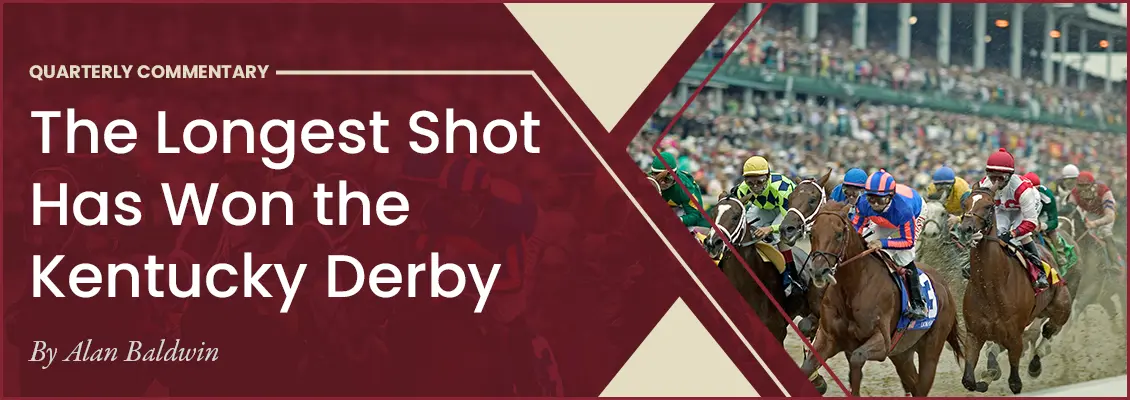
The unimaginable happens. If you didn’t catch the Kentucky Derby this year, we suggest that you check it out on YouTube. For context, Rich Strike’s chances of winning the Kentucky Derby were 80 to 1, which means that if someone bet $10, their bet would have returned $818. Furthermore, the likelihood of this happening was a little over a 1% chance, almost unimaginable. To spoil your YouTube search, Rich Strike not only won the Kentucky Derby, but he came from behind to win possibly the greatest race in our lifetime. Rich Strike’s victory proves that anything can happen even if you are behind, or the odds are stacked against you. We look forward to closing the books on the worst start for the stock market in over 50 years. Global equity markets continue to face headwinds of Russia’s invasion of Ukraine, supply chain disruptions from COVID lock downs in China, high inflation, and rising interest rates. Furthermore, fixed income markets have provided little protection for portfolios as the correlation between equities and bonds remains positive in 2022. The gates opened, the race began, and investors feel that they are behind the pack. The S&P 500 and NASDAQ reached bear market territory in the second quarter and the indexes are down about 20% and 30% year-to-date (YTD) respectively. The Dow Jones Industrial Average has fared better to start the year helped by its tilt toward value companies with the index down about 15% YTD. The performance dichotomy between the NASDAQ and Dow can be partly explained by their sector allocation. The NASDAQ Composite has an allocation over 60% to Information Technology and Communication Services, whereas the Dow has less exposure to technology and a higher allocation to Health Care. The information technology, communication services, and health care sectors are down about 27%, 30%, and 9% YTD. It is during times of high market volatility where we must rely on data over emotions as investors. Since 1942, a bear market has occurred about every six years for the S&P 500 and last on average just under a year. Whereas bull market periods last about 4.5 years and on average have a cumulative total return of over 150% (First Trust). Therefore, instead of preparing your portfolio for a bear market today, it may be more prudent to upgrade your portfolio to quality companies for the bull market of tomorrow. It may surprise some investors, but international equities (down about 18% YTD) have outperformed the S&P 500 this year. International markets have faced major headwinds caused by the Russian invasion and Chinese lock downs, but some countries like Australia have benefited from the rise in commodity prices contributing positively to market performance. Furthermore, Chinese equities may be a horse you want as easing COVID restrictions and potential additional stimulus may boost their equity market in the near-term. The race is not over until it is over and every household’s finish line is different. Some investors are focused on the finish line of retirement funding where others have education funding top of mind. Regardless of your household’s goal we work with our clients to create a plan and to stick to their plan during rain or shine. If a client abandoned their plan and missed just the 10 best days of the stock market from 1997 through 2021, they may have missed over 4% of annualized return (Invesco). Rich Strike was not the favorite, was not the leader, but he was the winner. Stick to your plan. We thank you for your continued support of our firm and look forward to our next phone call, zoom call, or hopefully an in-person meeting. As always, “you do the dreaming, we’ll do the math.”
Alone With My Thoughts – 06/15/2022

Today the Fed took another shot at inflation, raising interest rates by 75 basis points. During the pandemic in 2020-21, and also the Great Recession of 2008-09, the playbook was to throw money at the problem by either keeping interest rates at zero percent or by literally giving people money to spend our way out of a jam. The result of all the free money (trillions with a T) is the aggressive inflation which now needs to be addressed. The multi-trillion dollar question then is…can the Fed raise rates enough to slow the economy without throwing us into a recession and/or a much steeper downward spiral in stocks. The better question may be…are we fighting yesterday’s war and should we be putting our efforts towards freeing up the supply chains, loosening the grip of government controls on US businesses, and letting post-pandemic demand play itself out over a period of time. The only thing that is transitory is any Talking Head taking responsibility for their economic calls.
Alone With My Thoughts – 06/09/2022

Friday’s upcoming CPI report will unfortunately tell us the same story that we are living, that prices are higher and they are sticky at these levels. Inflation can be an insidious threat to our economy, acting like a silent tax on our day to day life. From our friends at 10-K Diver here are some pointers on dealing with inflation. Be a consistent earner, meaning now is the time to be valued in order to maintain and increase your income streams. Continue saving by being even more aware of what and how you are spending your money. Finally, inflation proof your portfolio by investing in companies that have pricing power, very manageable debt loads, and are capital light. Inflation is happening and will be working its way through the system for some time.
Alone With My Thoughts – 05/24/2022

Warren Buffet’s rule number one is to “not lose money”. His rule number two is “see rule number one”. That being said, our goal is to build long-term investment portfolios that can withstand the inevitable bear markets and recessions that cycle through any economy. We also are committed to protecting your assets from the unfortunate tremendous growth in Cyber Fraud. Everyone needs to be vigilant when it comes to their money and its place in the digital world.
Alone With My Thoughts – 05/06/2022

Yesterday, the White House again touted the fact that they have cut federal deficits by historic amounts the past two years. Just keep in mind that the deduction is only in the predicted yearly deficit, in other words the national debt is still going up in historic fashion, but just not quite as fast. In classic political double-speak, the Biden administration would have you believe that they were able to cut the deficit by $350 billion last year, but due to pandemic emergency spending running out, if they had done nothing, according to the Committee for a Responsible Federal Budget, the deficit growth would have slowed by $1 trillion, much more than what they are hanging their hat on. Whether Republican or Democrat, unfortunately our elected leaders do not appear to have the resolve to tackle governmental spending and now we get to deal with the effects of higher interest rates begotten from higher inflation. The more you repeat something the more likely you are to believe it.
This Is Not Your Father’s Market
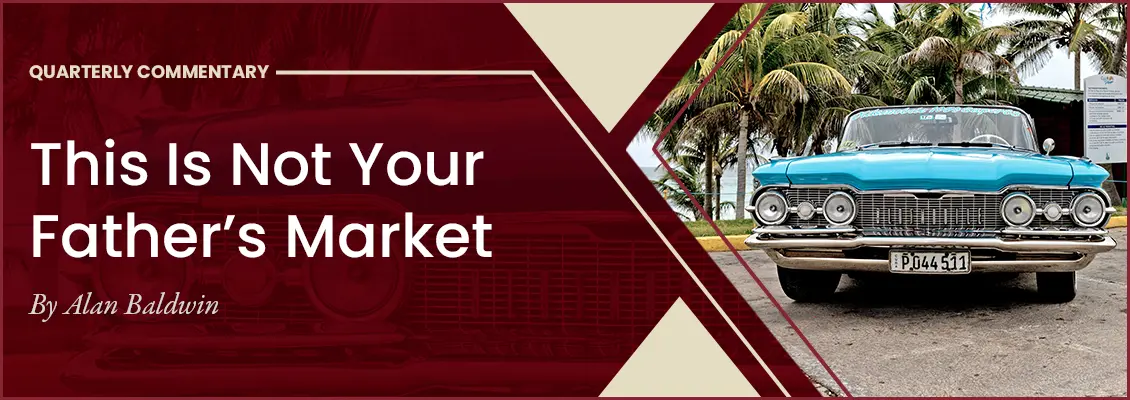
We need to go back 34 years to remember the infamous Oldsmobile commercial where the slogan was “This Is Not Your Father’s Oldsmobile.” The idea was that Oldsmobile had changed and evolved and their new image would resonate with a younger client base. In short, the advertisement ended up being more of a slow lane to a dead end than a revitalization of the brand. Today, there are parts of the global markets where this slogan does resonate, as well as areas where the market appears to have changed, but after looking underneath the hood you may uncover an engine that looks just like the past. Today is not your father’s bond market. On January 1st, 1988, the 10yr US Treasury Bond had a yield of 8.26% with inflation in 1988 at about 4.0% (inflation.eu). Therefore, a US Treasury Bond provided a real yield of about 4%. Fortunately, for bond investors, interest rates maintained a downward trend for the next 34 years. Today, the 10yr US Treasury Bond has a yield of about 2.4% with inflation red hot to start the year, coming in at nearly 8%. This combination produces a negative 6% real yield and creating a flat tire for your portfolio. While interest rates may remain in a trading range in the near term, they may likely rise as the Federal Reserve continues to raise rates. As interest rates rise, bond prices fall. Therefore, today’s fixed income climate has low, but rising yields and high inflation, which translated to about a -6% return for Investment Grade Bonds year to date (YTD). We believe it’s prudent to opportunistically manage your bond holdings to provide ballast for a portfolio without hindering your future growth. International equities (about -6% YTD return) may be worth a second test drive. International equities began the year outperforming their US counterparts but gave back their outperformance after the Russian invasion of Ukraine. We continue to monitor the war and hope for a peaceful resolution soon. With that said, the current market environment may provide opportunities in Developed and Emerging Markets as they continue to trade at a discount to US equities on Price-to-Earnings ratios and may be well positioned to grow during a period of higher commodity prices. International equities have given investors multiple head fakes in recent years, causing our team to remain cautious and selective, but we think this is the right time for a second test drive. The US equity markets are off to a choppy start for the year, with worries surrounding inflation, interest rate hikes, and the Russian invasion of Ukraine. Fortunately, March provided some relief as major indices rebounded off their lows. The Dow Jones and S&P 500 were down about 4% and 4.6% respectively, and the more technology and growth heavy NASDAQ is down about 9%. The US equity market today looks more like Tesla than Ford on the surface. However, it is legacy companies like Chevron, Berkshire Hathaway, and Coke that are providing strong returns for investors. Companies with the ability to adapt to the ever-changing marketplace, pass on cost to the consumer, and a strong balance sheet to weather a storm continue to deliver strong performance. We believe that the US equity market is still your father’s market. The market over time will continue to reward companies with strong earnings and fundamentals regardless of what the company looks like on the surface, as it is the numbers under the hood that will guide our decisions and future returns for our clients. We thank you for your continued support of our firm and look forward to our next phone call, zoom call, or hopefully an in-person meeting. As always, “you do the dreaming, we’ll do the math.”
2022 Bucket Strategy
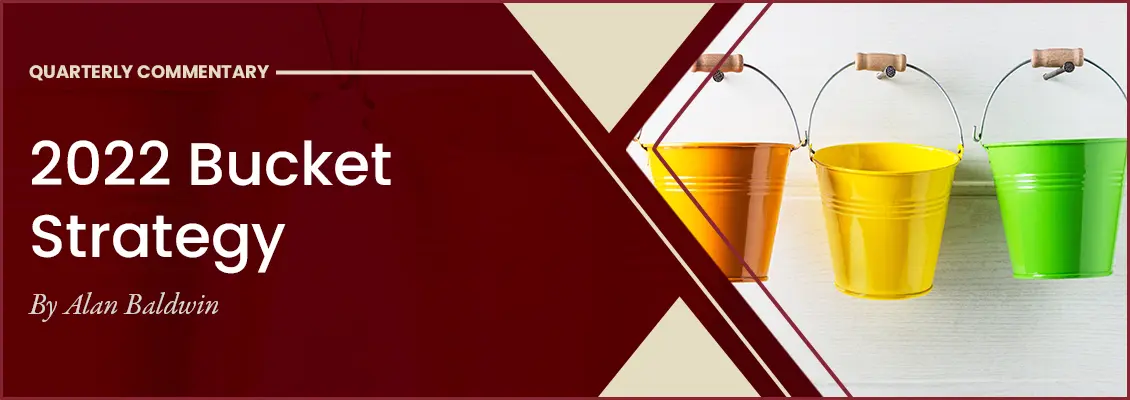
As each year ends, investors, business owners, and households alike begin thinking and maybe even dreaming about what the new year will bring. Will 2022 be an artist’s break out year, will “Buddy Buckets” shine in ACC basketball play, or will a household spend or save more? The latter begs to ask the question about budgeting and planning for the year ahead. We advise clients to use a bucket strategy for budgeting based on their individual financial plan. As one example, the 20-30-50 model suggests 20% savings, 30% wants (think socializing and travel), and 50% fixed bills like housing. Regardless, of what model works best for your family, we would like to focus on the savings portion today. Using a bucket strategy, we advise clients to break out their savings into three distinct buckets. Cash Bucket(Rainy Day fund): Depending on a household’s financial plan and investment phase the specific amount of cash we advise varies. However, an example may be 3 months of expenses for a young investor in the accumulation phase. Medium-Term Bucket: Comprised of an investment account or education planning (UGMA, 529 Plan, etc…). After your retirement bucket has been maxed out, this bucket can be used to invest the remainder of annual savings. Retirement Bucket: The retirement bucket includes employer-sponsored accounts like a 403(b) or 401(k) as well as individual retirement accounts like a Traditional or Roth IRA. We may advise clients to grow their Roth bucket as much as they can as we anticipate future tax increases. As for global markets in 2021, what a year! The S&P 500 grew about 29%, the Dow Jones Industrial Average was up about 21% and the NASDAQ rose about 22%. International Equities struggled to keep up with their US counterparts in 2021 but still rose by about 7%. Unfortunately, Investment-Grade Bonds (represented by the Bloomberg Aggregate Index) detracted from portfolio performance losing about 2% on the year. As a former colleague once coined, 2021 showed “diworsification” as the S&P 500 was the best game in town. As we look out into 2022, there are two major themes for investors – inflation and the transformation from a pandemic to an endemic disease. Inflation may remain a concern for some time which could cause the Federal Reserve to raise interest rates faster than the market expects. Therefore, we have been aligning our portfolios to overweight companies that have quality earnings and pricing power to pass along price increases to the consumer. In terms of COVID-19, it appears to be more and more evident that COVID-19 may look more and more like influenza as an endemic disease and will remain a health concern into the future. As COVID-19 (depending on the variety of strains) becomes more common place, it may alleviate disruptions in everyday life. Therefore, families and investors may be able to finally take that long awaited vacation or be able to visit with family more often than in the previous two years. We believe this transformation will cause volatility in global equities, but an overall strong backdrop for increased corporate earnings in the years ahead. We want to wish everyone a healthy and a prosperous 2022 that fills all of your life buckets! As always, “you do the dreaming, and we’ll do the math!”
Alone With My Thoughts – 12/29/2021

Happy New Calendar Year It is time to flip the calendar on another year and also to reflect on what has been a very impressive market in 2021. Speaking of markets and calendars, the total return on the S&P 500 (the 500 largest US companies) has been quite impressive for the past 95 years, or dating back to 1926. Think about this, over this period we have seen countless historical events…wars, depressions, recessions, embargoes, financial crisis’s, and throw in a pandemic, yet the market has still had a 10.3% average annual return. Remarkable. Even more remarkable, over these 95 years we have only seen seven calendar years where the market is down by 14% or more, just seven. On the flip side we have seen 48 years (more than half) up 14% or more. We cannot predict the future but we can use the odds to our advantage. Here’s to a healthy and happy 2022! (research source Ibbotson Associates)
Alone With My Thoughts – 12/14/2021

According to a recent Wall Street Journal article, the value of tax-loss harvesting is quite impressive. Tax loss harvesting is basically managing long and short term gains to the investors advantage. Using someone in the 25% income tax bracket, their studies show that in a strong market, managing taxable gains and losses can add 1.1 to 1.42% to annual returns. Even more impressive, during significant downturns when the S&P is negative, this harvesting can add about 3.21% to yearly performance. So whether the market has been naughty or nice, tax management can be a gift to returns.